
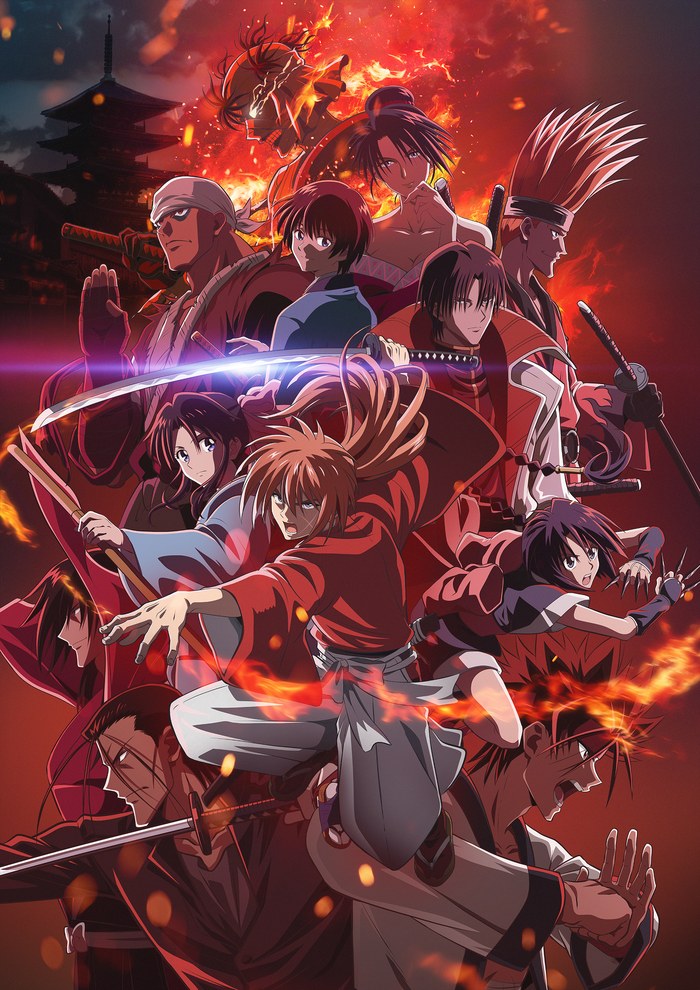
Rurouni Kenshin
The deadliest swordsman of the revolution now refuses to kill.
Last updated: 10 November 2026
Rurouni Kenshin is the 1996 anime of Nobuhiro Watsuki's manga, animated first by Studio Gallop and then Studio Deen across 95 episodes, directed by Kazuhiro Furuhashi. Former assassin Kenshin Himura, once feared as Battosai the Manslayer, has sworn never to kill again and protects people with a reverse blade sword while living at Kaoru Kamiya's dojo in Tokyo. People watch it for the found family warmth, the outstanding Kyoto arc, and a hero whose greatest fight is against his own past.
About Rurouni Kenshin
Kenshin Himura was the most feared assassin of the Bakumatsu war. Now he wanders Meiji era Japan with a reverse blade sword and a vow never to kill, living at the Kamiya dojo with Kaoru, Yahiko, Sanosuke and Megumi. Old enemies and a rising threat in Kyoto keep pulling him back toward the man he used to be. The 1996 series runs 95 episodes, mixing gentle comedy, sword action and a serious question about whether people can truly change.
Rurouni Kenshin is a TV anime from 1996, first released in Winter 1996. It belongs to the Action and Drama and Romance genres and is listed as a completed series. The summary above is written by the AnimeYug team in our own words.
Story & Plot
Ten years before the story opens, the Bakumatsu war tore Japan apart, and a young swordsman named Kenshin Himura earned the name Battosai the Manslayer killing for the revolution. When peace came, he vanished. Now, in 1878, he wanders Japan as a gentle, soft spoken man carrying a sakabato, a sword with the blade on the wrong side, so it can strike without cutting. He has sworn he will never kill again. His whole life since has been an attempt to keep that promise in a world that keeps handing him reasons to break it.
In Tokyo he crosses paths with Kaoru Kamiya, a young woman running her late father's dojo, whose school teaches that the sword should protect life. A killer is using Kenshin's old name to commit murders, and stopping him puts Kenshin in Kaoru's debt and then in her home. The dojo slowly fills up: Yahiko, a proud orphan learning the sword; Sanosuke, a former street fighter who becomes Kenshin's closest friend; and Megumi, a doctor with a painful past of her own. Between sword fights there is cooking, bickering and quiet days, and the series cares about those days as much as the battles.
The story turns serious in the Kyoto arc. Shishio Makoto, Kenshin's successor as an assassin, survived being burned and betrayed by his own side, and now plans to overthrow the Meiji government with an army of fighters. Kenshin leaves the dojo behind and travels to Kyoto, where old allies and enemies gather on both sides. It is the part of the series fans praise most, because Shishio is what Kenshin could have become, and every fight asks whether a man can stay merciful when mercy keeps costing him.
The 1996 series closes with anime original stories after Kyoto. Separately, the Trust and Betrayal OVA tells the wartime story the TV series only hints at, showing how Kenshin became Battosai and where his cross shaped scar came from. It is darker in tone than the series, and many viewers treat it as essential viewing alongside it.
Story Arcs & Episode Guide
The Rurouni Kenshin anime is split into story sagas. Here is every saga in order, with its episodes and years.
| Arc | Episodes | Years | About |
|---|---|---|---|
| Wandering Samurai (Season 1) | Episodes 1-27 | 1996 | Kenshin settles at the Kamiya dojo and old figures from the revolution keep finding him. |
| Legend of Kyoto (Season 2) | Episodes 28-62 | 1997 | Kenshin leaves for Kyoto to stop Shishio Makoto, a fellow former assassin building an army. |
| Tales of the Meiji (Season 3) | Episodes 63-95 | 1997-1998 | Anime original stories after the Kyoto arc, as the dojo group faces smaller, stranger troubles. |
Why Watch Rurouni Kenshin
- A hero defined by a vow not to kill, tested in every serious fight
- The Kyoto arc and Shishio, a villain who mirrors Kenshin's past
- A warm found family at the Kamiya dojo between the battles
- Trust and Betrayal, widely praised as one of the finest anime OVAs
- Two full tellings to choose from: the 1996 classic or the 2023 remake
Who Is It For?
Best for teens and up. Sword violence is present but rarely graphic. Trust and Betrayal is much darker and bloodier than the TV series and suits adults.
Main Characters
View all characters →Voice Actors
The Japanese voices behind the main characters of Rurouni Kenshin.
- Kenshin HimuraMain characterJapanese voiceMayo Suzukaze
- Kaoru KamiyaMain character, dojo masterJapanese voiceMiki Fujitani
- Sanosuke SagaraMain characterJapanese voiceYuji Ueda
- Yahiko MyojinKaoru's studentJapanese voiceMiina Tominaga
- Megumi TakaniDoctorJapanese voiceMika Doi
Staff & Production
- Original Creator
- Nobuhiro Watsuki
- Animation Studio
- Studio Gallop (episodes 1-66), Studio Deen (episodes 67-95)
- Director
- Kazuhiro Furuhashi
- Music
- Noriyuki Asakura
Manga & Source Material
Nobuhiro Watsuki's manga ran in Weekly Shonen Jump from 1994 to 1999 across 28 volumes. It mixes real Meiji era history with fictional sword schools and larger than life fighters.
- The manga ran in Weekly Shonen Jump from 1994 to 1999 and fills 28 volumes.
- The story is set in 1878, the 11th year of the Meiji era, about a decade after the Bakumatsu conflict.
- Kenshin's fighting style, Hiten Mitsurugi-ryu, is fictional, created for the manga.
- The Kyoto arc adapts the manga closely, while the TV series' third season is mostly anime original material.
- A follow up manga, The Hokkaido Arc, began years later and is the basis of the story continuing after the original run.
Music
Sobakasu became one of the signature anime openings of the 90s. Noriyuki Asakura's score mixes rock energy with traditional Japanese instruments, which suits a story caught between the sword age and modern Japan.
Opening Themes
- “Sobakasu”by Judy and MaryThe first and best known opening, used for the first half of the series.
- “1/2 (One Half)”by Makoto KawamotoSecond opening, used later in the Kyoto run.
Ending Themes
- “Tactics”by The Yellow MonkeyFirst ending theme, used for the opening run of episodes.
- “The Fourth Avenue Cafe”by L'Arc-en-CielA later ending theme from the Kyoto period of the series.
Series Timeline
- 1994-1999
Nobuhiro Watsuki's manga runs in Weekly Shonen Jump, 28 volumes.
- 1996-1998
The TV series airs 95 episodes, animated by Studio Gallop, then Studio Deen.
- 1997
The theatrical film, Requiem for the Ishin Patriots, is released.
- 1999
Trust and Betrayal, the four part OVA about Kenshin's past, is released.
- 2001-2002
Reflection, a second OVA with an original sequel story, follows.
- 2023
LIDENFILMS begins a full remake with a new cast, a modern alternative telling.
Release Schedule
- Premiere
- 10 January 1996 on Fuji TV
- Broadcast
- Fuji TV in Japan; in the US it aired on Toonami in 2003
- Streaming
- 2023 remake on Crunchyroll; 1996 series on Hulu and Crunchyroll where available
- Episodes
- 95 episodes (1996 series), plus OVAs and a 1997 film
The 1996 series is complete. The 2023 remake is a separate production with its own schedule. Details as of 10 November 2026.
Quick Answers
Is Rurouni Kenshin finished?
Yes. Rurouni Kenshin has finished airing, so you can watch the complete story from start to end without waiting for new episodes.
What genre is Rurouni Kenshin?
Rurouni Kenshin is a Action and Drama and Romance anime. You can browse more titles like it on our Action anime page.
When did Rurouni Kenshin release?
Rurouni Kenshin first released in Winter 1996. It is a TV series.
Where can I watch Rurouni Kenshin?
The 2023 remake streams on Crunchyroll. The 1996 series has streamed on Hulu and Crunchyroll in North America, though its line up changes over time, so it is worth checking both. Trust and Betrayal is often sold separately on home video.
How many episodes does Rurouni Kenshin have, and is it finished?
The 1996 series has 95 episodes and is finished. The 2023 remake is a separate, ongoing retelling with its own episode count. Trust and Betrayal adds a four part OVA.
What is the Rurouni Kenshin watch order?
For the classic version: the 1996 series, then Trust and Betrayal for Kenshin's past (you can also watch it first if you prefer a serious tone). The 1997 film and Reflection fit after the series, though Reflection is a separate, sadder take on the ending. The 2023 remake can be watched on its own at any point.
Is there a remake of Rurouni Kenshin?
Yes. LIDENFILMS began a full remake in 2023 with a new cast, starting again from the manga's first chapters. It is a modern alternative telling, not a sequel, and the 1996 series remains complete on its own.
Who voices Kenshin Himura?
In the 1996 series, Kenshin is voiced in Japanese by Mayo Suzukaze. In the Media Blasters English dub he is voiced by Richard Hayworth, a stage name of Richard Cansino.
Watch Order
Here is the release order for Rurouni Kenshin and the series connected to it. Start at step 1 and work your way down.
- 1Rurouni Kenshin (1996 TV series)Start here. 95 episodes, with the Kyoto arc in the middle (episodes 28-62).
- 2Rurouni Kenshin: Trust and Betrayal (1999 OVA)Four part OVA about Kenshin's wartime past. Watch after the TV Kyoto arc for full impact, or first if you want the serious story up front.
- 3Rurouni Kenshin: The Movie (1997)A standalone cinema story. Optional, fits after the Kyoto arc.
- 4Rurouni Kenshin: Reflection (2001-2002 OVA)An original sequel OVA with a much sadder tone. Optional, and its ending differs from the manga.
- 5Rurouni Kenshin (2023 remake, LIDENFILMS)A modern retelling from the start of the manga with a new cast. Watch on its own, before or after the classic series.
Where to Watch
Rurouni Kenshin is officially available to stream on these platforms:
Streaming availability changes often and differs by country. Please check the platform in your region.