
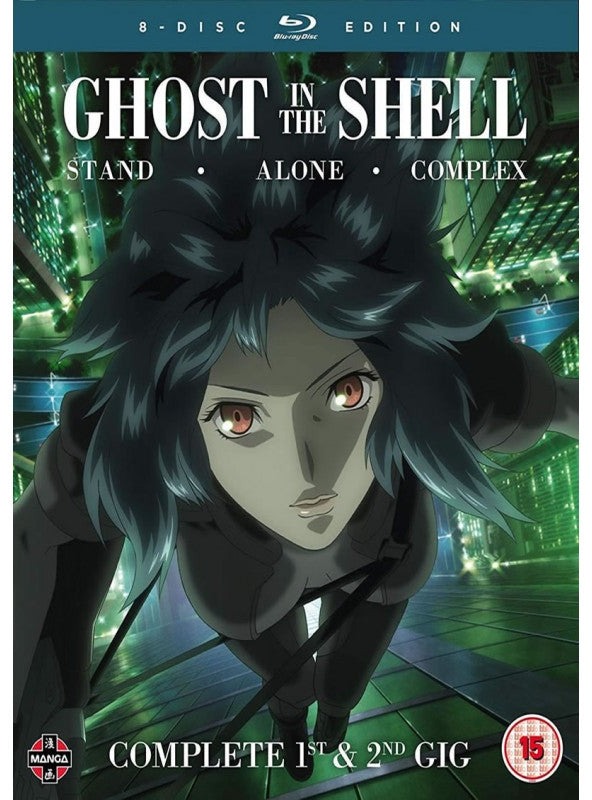
Ghost in the Shell: Stand Alone Complex
Section 9 versus the Laughing Man: the thinking viewer's cyberpunk masterpiece.
Last updated: 10 November 2026
Ghost in the Shell: Stand Alone Complex is Production I.G's 26 episode TV anime written and directed by Kenji Kamiyama, first aired from October 2002. Set in 2030, it follows Major Motoko Kusanagi and Public Security Section 9, an anti cybercrime unit, through standalone cases and the long Laughing Man investigation. Atsuko Tanaka voices the Major and Mary Elizabeth McGlynn voices her in English. The story continues in 2nd GIG, the film Solid State Society and later SAC_2045.
About Ghost in the Shell: Stand Alone Complex
Stand Alone Complex builds its own continuity from Masamune Shirow's manga, separate from the famous 1995 film. In a Japan where most people have cyberbrains and full body prosthetics are common, Section 9 handles the crimes this technology creates: hacked ghosts, runaway tanks, political assassinations and information terrorism. Season 1 mixes self contained cases with a building arc about the Laughing Man, a legendary hacker whose corporate blackmail case hides a scandal about a suppressed cure for cyberbrain disease. Yoko Kanno's score ranges from electronica to Origa's Russian language opening.
Ghost in the Shell: Stand Alone Complex is a TV anime from 2002, first released in Fall 2002. It belongs to the Sci-Fi and Action and Mystery genres and is listed as a completed series. The summary above is written by the AnimeYug team in our own words.
Story & Plot
By 2030, the line between human and machine is a settings menu. Cyberbrains link minds to the network, prosthetic bodies are routine, and the Major, Motoko Kusanagi, is a full body cyborg who has lived in artificial bodies since childhood. She fields commands Section 9, a small, elite unit under Chief Daisuke Aramaki, staffed by the ex Ranger Batou, the lightly augmented ex detective Togusa, and a support team of hackers, snipers and cheerful spider tanks called Tachikoma.
Episodes alternate between standalone cases and complex episodes advancing one long thread: the Laughing Man, a hacker who vanished six years earlier after kidnapping a corporate president live on television, and who now seems to be active again. Behind the meme like logo and the copycat crimes sits a story about a cheap, effective treatment for cyberbrain sclerosis that medical corporations buried to protect their profits.
The second season, 2nd GIG, turns to politics: refugees, a charismatic revolutionary, a nuclear threat and the manipulator Hideo Kuze, whose shared past with the Major gives the season its emotional core. The film Solid State Society jumps forward again, to a Section 9 the Major has left, chasing a hacker called the Puppeteer through a case about stolen children.
Across all of it, the series keeps asking its central question with unusual seriousness: in a world of copied memories and replaceable bodies, what makes a person themselves? It answers through its characters rather than lectures, which is why it still feels sharper than most science fiction on television.
Story Arcs & Episode Guide
The Ghost in the Shell: Stand Alone Complex anime is split into story sagas. Here is every saga in order, with its episodes and years.
| Arc | Episodes | Years | About |
|---|---|---|---|
| Season 1: The Laughing Man | 26 episodes | 2002-2003 | Standalone cases alternate with the Laughing Man investigation, a corporate scandal hidden behind a legendary hacker. |
| 2nd GIG | 26 episodes | 2004-2005 | The Individual Eleven, refugee politics and Hideo Kuze. A more political, serialised season. |
| Solid State Society | Feature film | 2006 | A TV film set two years after 2nd GIG, with Togusa leading the field team and the Major working alone. |
| SAC_2045 | 24 episodes | 2020-2022 | The CG continuation on Netflix, with Section 9 reformed as mercenaries facing the post human threat. |
Why Watch Ghost in the Shell: Stand Alone Complex
- Produced by Production I.G, written and directed by Kenji Kamiyama
- Yoko Kanno's score, with Origa's Inner Universe as the opening
- Atsuko Tanaka and Mary Elizabeth McGlynn as the Major in Japanese and English
- The Laughing Man arc is a landmark of serialised anime storytelling
- Continued in 2nd GIG, Solid State Society and SAC_2045
Who Is It For?
Stand Alone Complex is adult science fiction: dense dialogue, political plots, violence and philosophical ideas about identity. It suits older teens and adults who enjoy crime procedurals and hard sci fi. Viewers who want constant action should know the talk is the action here, and it is excellent talk.
Main Characters
View all characters →Voice Actors
The Japanese voices behind the main characters of Ghost in the Shell: Stand Alone Complex.
- Motoko KusanagiSection 9's field commander, a full body cyborg known as the MajorJapanese voiceAtsuko Tanaka
- BatouEx Ranger, the Major's right hand, famous for his cybernetic eyesJapanese voiceAkio Otsuka
- TogusaFormer police detective, the least cyberised member of the teamJapanese voiceKoichi Yamadera
- Daisuke AramakiChief of Section 9, a political operator of the old schoolJapanese voiceOsamu Saka
- IshikawaSection 9's senior information warfare specialistJapanese voiceYutaka Nakano
- SaitoThe team's sniper, with a cybernetic eye linked to satellitesJapanese voiceToru Okawa
Staff & Production
- Original Creator
- Masamune Shirow
- Director and Series Composition
- Kenji Kamiyama
- Character Design
- Hajime Shimomura
- Music
- Yoko Kanno
- Animation Studio
- Production I.G
Manga & Source Material
Stand Alone Complex is based on Masamune Shirow's manga Ghost in the Shell, first serialised in Young Magazine from 1989. The TV series builds a fresh continuity that borrows the manga's characters and ideas rather than adapting its plot directly, giving Kamiyama room to write original cases. Kodansha publishes the manga in English.
- Created by Masamune Shirow
- The original manga was serialised in Young Magazine from 1989 to 1990, with later sequel volumes
- Stand Alone Complex is its own continuity, separate from the 1995 film and from Arise
- The series title refers to copycat crimes and ideas that spread without an original source
- The Laughing Man's logo and Salinger references come straight from the season's literary streak
- Shirow's manga also inspired the 1995 film by Mamoru Oshii
Music
Yoko Kanno's score is half the show's atmosphere: electronica, jazz, choral pieces and songs in Russian, English and Latin, many sung by Origa and Ilaria Graziano. The soundtracks are landmarks in their own right.
Opening Themes
- “Inner Universe”by OrigaSeason 1 opening, sung in Russian, English and Latin, composed by Yoko Kanno.
- “Rise”by OrigaThe 2nd GIG opening.
Ending Themes
- “Lithium Flower”by Scott MatthewSeason 1 ending.
- “Living Inside the Shell”by Steve ConteThe 2nd GIG ending.
Series Timeline
- 1989
Masamune Shirow's Ghost in the Shell manga begins in Young Magazine.
- 1995
Mamoru Oshii's film makes the franchise world famous. Stand Alone Complex later builds a separate continuity.
- October 2002 to October 2003
Season 1 airs in Japan, 26 episodes from Production I.G.
- January 2004 to January 2005
2nd GIG airs, 26 more episodes, turning to refugee politics and the Individual Eleven.
- 2006
The TV film Solid State Society continues the story, with the Major outside Section 9.
- 2020-2022
SAC_2045 brings the continuity back on Netflix in full CG, with Kamiyama returning.
Release Schedule
- Premiere
- 1 October 2002
- Broadcast
- Animax and Perfect Choice in Japan, Adult Swim in the US
- Streaming
- Tubi and The Roku Channel (US, free with ads)
- Episodes
- 26 (Season 1), plus 26 in 2nd GIG
Details as of 10 November 2026.
Quick Answers
Is Ghost in the Shell: Stand Alone Complex finished?
Yes. Ghost in the Shell: Stand Alone Complex has finished airing, so you can watch the complete story from start to end without waiting for new episodes.
What genre is Ghost in the Shell: Stand Alone Complex?
Ghost in the Shell: Stand Alone Complex is a Sci-Fi and Action and Mystery anime. You can browse more titles like it on our Sci-Fi anime page.
When did Ghost in the Shell: Stand Alone Complex release?
Ghost in the Shell: Stand Alone Complex first released in Fall 2002. It is a TV series.
Where can I watch Stand Alone Complex?
In the US, the series streams free with ads on Tubi and The Roku Channel, and SAC_2045 is on Netflix. Availability changes often and varies by country, so check your local listings.
Do I need to watch the 1995 Ghost in the Shell film first?
No. Stand Alone Complex is a separate continuity with the same characters. You can start with this series, then watch the film later as an alternate take.
Who voices Major Kusanagi?
Atsuko Tanaka voices her in Japanese throughout Stand Alone Complex. Mary Elizabeth McGlynn voices her in the English dub and is many fans' definitive Major.
How many episodes does Stand Alone Complex have?
52 episodes across the two TV seasons, 26 each, plus the Solid State Society film and the 24 episodes of SAC_2045 that continue the same continuity.
What is the difference between Stand Alone and Complex episodes?
Stand Alone episodes are self contained cases. Complex episodes advance the season's main investigation, the Laughing Man in Season 1. The show labels them in the episode guides, and the mix is deliberate.
Watch Order
Here is the release order for Ghost in the Shell: Stand Alone Complex and the series connected to it. Start at step 1 and work your way down.
- 1Ghost in the Shell: Stand Alone Complex (2002)Season 1: start here. The Laughing Man arc, 26 episodes.
- 2Ghost in the Shell: S.A.C. 2nd GIG (2004)Season 2: the Individual Eleven and Hideo Kuze, 26 episodes.
- 3Ghost in the Shell: Stand Alone Complex, Solid State Society (2006)The film sequel, set two years after 2nd GIG.
- 4Ghost in the Shell: SAC_2045 (2020)The later continuation of this continuity on Netflix, two seasons. Optional after Solid State Society.
- 5The Laughing Man and Individual Eleven compilationsOptional. Feature length re edits of each season's main arc, useful as a refresher, not a replacement.
Where to Watch
Ghost in the Shell: Stand Alone Complex is officially available to stream on these platforms:
Streaming availability changes often and differs by country. Please check the platform in your region.